Sunday, June 17, 2012

Sulfonamides

More additions to the antibiotic range....

Sulfonamides (f vs. ph?? - it's an f in the BNF) are:
    TRI methoprim
    Co TRI moxazole

So think of someone from the network 3 (TRI) trying to sell you a phone: "sell-phone...amide.....sulfonamide".

The other antibiotics are available here.

Thursday, June 14, 2012

Monoclonal Tumour Markers

  • CA 125 = Ovarian Cancer
  • CA 19-9 = Pancreatic Cancer
  • CA 15-3 = Breast Cancer
 *these are usual associations, it is possible that each of these are raised in other cancers (CA125 also found in pancreatic, gastric, colonic, breast)

Tuesday, June 12, 2012

Alternative Bristol Stool Chart

Can't take the credit for this one (was one of my lecturer's) - it's a pretty good way of taking a bowel habit history:


Sunday, May 27, 2012

B-cell lymphoma genetic links

Genetics of lymphomas - translocations cause overexpression of the following genes which cause the disease:
  • myc - Burkitts + B & T-cell lymphomas
  • bcl2 = follicular B-cell lymphoma
  • bcl3 = chronic B-cell lymphoma
  • bcl6 = diffuse  B-cell lymphoma
  • any other genes = acute T-cell lymphoma
So you can use this mirror image to remember the bcl genes:

Friday, May 25, 2012

Kartagener's Syndrome

Here's another eponymous syndrome named Kartagener's (German physician, 1933)*. It's a triad of features:
  • Dextrocardia or Situs inversus
  • Brochiectasis
  • Recurrant sinusitis
It's more scientifically known as primary ciliary dyskinesia - meaning cilia in the body don't beat properly. This is a problem during development where you need correctly beating cilia to put your organs in the right place (the cilia cause little waves of growth factor to swoosh around). If they beat the wrong way you get situs inversus or dextrocardia. If they don't beat at all it's situs ambiguus and organs end up in random places.

Here's my random picture for remembering this syndrome:

 
This heart (dextrocardia) in a cart (Kartageners) was traveling past a wrong way sign (..a..situs...sinusitis) and crashed into a tree (broken tree = broken bronchial tree = bronchiectasis).


* Kartagener M (1933). "Zur Pathogenese der Bronchiektasien: Bronchiektasien bei Situs viscerum inversus". Beiträge zur Klinik der Tuberkulose. 83 (4): 489–501.
* also... Situs Solitus is the normal positioning of organs in the body.

Thursday, May 24, 2012

Cerebral Toxoplasmosis

Disease of the immunocompromised. Acute onset focal neurological deficit, usually hemispherical (hemiparesis, visual field disturbance). Can be accompanied by fever. Imaging shows characteristic ring-enhancing lesions:

Monday, May 21, 2012

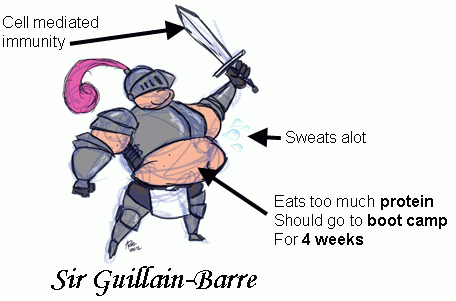
Guillain-Barre Syndrome

Another eponymous syndrome named by a French physician at the turn of the century.
  • It is an acute, inflammatory, post-infectious, ascending polyneuropathy (2:100,000).
  • Caused by (??): post viral (often: Campylobacter jejuni or CMV) cell mediated response against peripheral gangliosides. 
  • Polyneuropathy begins peripherally and progresses centrally - if it reaches respiratory/bulbar areas this is bad.
  • Often causes autonomic dysfunction (sweating, tachycardia, dysrhthmias)
  • CSF shows lots of protein  (>5.5g/L)
  • Develops over around 4 weeks.
  • Most important investigation: spirometry
So to remember these random facts I think of this knight character: Sir Guillain-Barre...
 * boot camp - to reflect that neuropathy often begins in feet (boot) and most commonly caused by CAMPylobacter Jejuni.
** also note pronounciation - gwee-awn barr-ay (in your best french accent)

Sunday, May 20, 2012

Pleural Effusions

Pleural effusions can be exudative (>30g/L protein) or transudative (<30g/L protein). Things that commonly cause effusions of each type are:
Also light's criteria - if any of the following are true then = exudative:
  • Pleural/Serum protein ratio > 0.5
  • Pleural/Serum LDH ratio > 0.5
  • Pleural fluid LDH > 2/3 of serum LDH level.

Monday, April 30, 2012

Na+ and K+ in Addisons and Cushings

On the ward the other day 3 of us got very confused by the changes in K+ and Na+ in addisions, Cushings and Conns. We worked back to first principles and figured it out in the end, but to save time I thought of this blatant generalisation:

Addisions can kill you, Cushings and Conns can't.

Helps me to remember that K+ is high in addisions but low in Cushings and Conns (follows that Na+ is the opposite).

* disclaimer: I'm sure cushings and conns could kill you, and addisons might not. Anyway the point is how to remember the changes in K+ !

ECG Update

A while back I posted this about ECG's. Here's an update for those who found it useful - now including which coronary artery each lead relates to:

  • Coffee Cup with circle around it = Latte = Lateral leads (supplied by CIRCumflex)
  • Info sign = InfeRior, supplied by right coronary (infoRmation)
  • Ant with football = Anterior leads, the ant is a bit of a "lad" (left anterior descending)
  • Septal leads = equally supplied by RCA and LAD depending on anatomical variance.

Sunday, April 29, 2012

Route planner

Here's a useful resource for anoyone on central london firms at Barts....

Monday, January 30, 2012

Weber's and Rinne's test

This one is pretty well known but thought I'd add it anyway.

Weber's test -
tuning fork on forehead.
Loud on one side:
= conductive loss on same side
or
= sensorineural loss on opposite side

Rinne's test -
tuning fork next to ear and on mastoid process.
Normal = Air louder than bone (+ve rinne's)
Conduction loss = Bone louder than air (-ve rinne's)
Sensorineural = Both the same

N
ext time you see someone actually doing this test, please take a photo and sent it to me!

Friday, January 13, 2012

Anterior Pituatary Hormones


These are the anterior pituatary hormones.

Think of an ant (Anterior) swimming around in a bowl of milk (Prolactin) with some alphabet cereal (All the hormones which are abbreviated).

Posterior pituatary does everything else (Oxytocin + Vasopressin).

Tuesday, January 03, 2012

Grouch-er's

Gaucher's Disease

This is a lysosomal storage disease caused by hereditory deficiency of glucocerebrosidase. Characterised by hepatomegally and splenomegally due to lipid not being broken down by glucocerebrosidase.

So...here is oscar the grouch (Gaucher's) in his dustbin (distended abdomen from splenomegally & hepatomegally) drinking Cerebro-cider (gluco-cerebro-sidase) which causes neurological complications.

Friday, September 23, 2011

Antibiotic Classification

Please use the buttons above to vote for whether this one works. Have been working on this for a while and it may only work in my head!
Each picture above is just a way of linking a random antibiotic name with an actual class. Such as Quinolones -> "Quick Sip" -> Ciprofloxacin.

For adverse reactions add:
  • The pepsi van is driven by a red man (vancomycin causes "red man" syndrome)
  • The gentleman has to shout "ALLO GUVNOR" since he is deaf (ototoxicity in gentamycin)

Also, on the penicillin side of things here's how I remember the Beta-Lactams:

Sunday, September 11, 2011

ECG interpretation with one glance

Often I find someone hands you an ecg print out, points to one lead and says "...obviously the defect is antero-lateral to the septal portion of the apex" (or something similar). So here's a neat picture based way to remember which lead covers which area.

All ECG's are presented in this format:
and I like to superimpose the following picutres:
So Lead I, aVL, V5 and V6 are lateral (picture of Caffe Latte), Lead II, III and aVF are inferior (Info sign), chest leads V1 and V2 are septal (7 in french, sept), chest lead V3 + V4 are anterior (Ant). Don't worry about aVR - I don't think anyone ever does. So just like in the kids game, all you have to do is remember where each of the pictures are.

Wednesday, September 07, 2011

What is an EEG?

Ok, so people often get confused over what exactly an EEG is. Time to look at some EEG fish....
In our fish tank we have loads of fish swimming around randomly. There are also 3 cameras looking at different parts. The first sees only one fish (how sad), the next sees 3 fish swimming to the left and the next sees loads of fish swimming to the right. If we add in a bonus camera then we could probably figure out which way the fish were swimming at a certain depth.

Replace cameras with electrodes and fish with action potentials and you've got an EEG. Remember the crazy squigly line trace you get from an electrode is the result of groups of neurons (fish) firing (swimming).

Thursday, June 23, 2011

Signs of Infective Endocarditis

A series of hand gestures to remember the signs of infective endocarditis.
  • Live long and prosper (Captain Janeway) - janeway lesions found in the palm and soles of foot.
  • Spider upside down in OS-tralia - oslers nodes found in finger pads and toes.
  • Nails - splinter haemorrhages

Wednesday, June 08, 2011

Bulbar Nerve Lesions

A lesion in the vagus nerve (CNX) causes the uvulA to deviate Away from the side of the lesion (uvula to the right, lesion on left side of brain).

A lesion in the hypoglossal (CNXII) causes the Tonge to deviate Towards the lesion (deviation to the left = lesion on the left).